
Limescale in the shower head: removing it and preventing it
Morning shower: half the nozzles give nothing, three jets spray sideways across the shower curtain. The shower head is scaled up – a constant topic in hard-water areas. A few simple steps get it under control.
How can you tell that a shower head is scaled up?
- The spray gets weaker, even though you turn the tap on just as far as always.
- Some jets spray off sideways, while other nozzles stay completely dry.
- White or grey crusts sit on the shower plate, especially around the nozzles.
- The water comes out unevenly, as if the shower were “stuttering”.
Why does the shower head scale up?
After showering, water stays in the fine nozzles. It evaporates and the dissolved limescale stays behind – layer by layer, until the opening is blocked. The harder the water, the faster this happens. How hard your water is, you can read in our guide Anti-limescale shower filters.
Quick help: silicone nubs
Many shower plates have soft silicone nubs. Simply rub over the nubs with a finger or soft cloth while the water is running – the limescale crumbles out. For the Smarald® wellness shower there is the silicone nub shower plate with anti-limescale function as a retrofit.
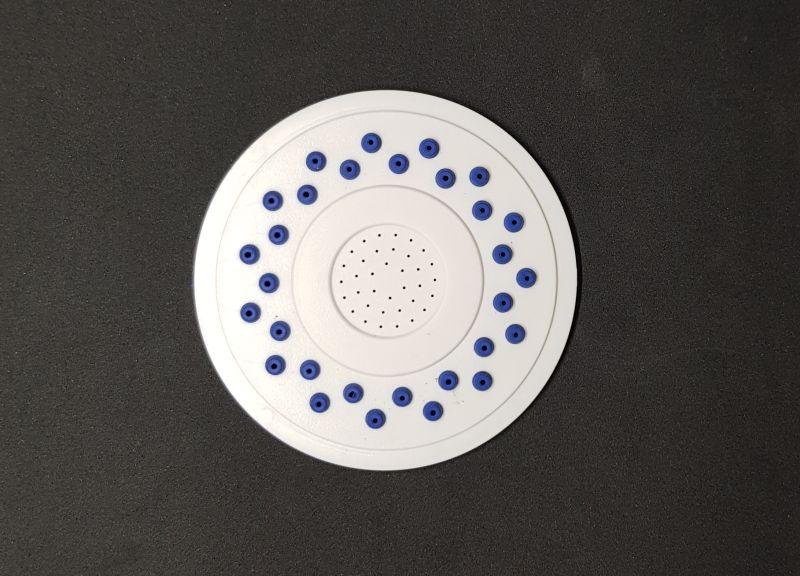
Descaling a shower head: step by step
For ordinary shower heads without a filter, a bath in an acid solution helps. But only if your shower head manufacturer allows it, and no longer than necessary: acid can attack chrome, coatings and seals. The manufacturer's care instructions always take priority.
- Unscrew it. Turn the hand shower off the hose – this can usually be done by hand. If you do need pliers, put a cloth in between so the chrome does not get scratched.
- Remove the washer and strainer. There is a rubber washer in the connection, often a small strainer as well. Neither goes into the acid – just rinse them with water.
- Soak it. Place the shower head in the solution (for mixtures, see the table below) so that all the nozzles are covered.
- Finish off. Rub off the loosened limescale with a soft brush or an old toothbrush, and press the nubs through with your finger.
- Rinse thoroughly. Rinse the shower head with clean, cold water – inside and out.
- Screw it back on. Insert the washer correctly, screw on hand-tight and let the water run through briefly.
Fixed overhead shower: the bag method
A rain shower or overhead shower often cannot simply be unscrewed. In that case, fill a sturdy freezer bag about halfway with the diluted solution, pull it over the shower head and secure it with a rubber band or cable tie. Important: all the nozzles must hang in the liquid. After the soaking time, remove the bag over a bucket, rub the nozzles and flush the shower with cold water for a few minutes.
Household remedies compared
| Remedy | Mixture | Soaking time | Caution |
|---|---|---|---|
| Citric acid (powder) | 1–2 tablespoons per 1 l of cold to lukewarm water | 15–60 minutes | do not mix with hot water |
| Vinegar essence (25 %) | 1 part to 5 parts water | 30–60 minutes | smell; can attack seals; some manufacturers advise against it |
| Household vinegar (5 %) | 1:1 with water | 30–60 minutes | never undiluted and not overnight |
| Denture cleaning tablets | 1–2 tablets in water | 30–60 minutes | only for light limescale |
| Bicarbonate of soda / baking powder | – | – | hardly dissolves limescale at all |
Why not hot citric acid? In a warm solution calcium citrate forms – a poorly soluble white coating that immediately settles on the shower head again. Citric acid works best cold to lukewarm.
Careful with filter showers: filter cartridges and mineral fillings must never go into vinegar or acid. With a filter shower, first remove the filter insert and clean only the shower plate or housing as described in the instructions for your model.
Don't forget the strainer, hose and tap
If there is still little water coming out after descaling, the problem is often not in the shower plate at all. Check the small strainer in the hose connection: limescale crumbs and sand collect there. Rinse it, tap it out, done. Do not put the shower hose itself in acid – only clean the nuts at the ends. If the hose is brittle inside or twisted outside, a new one is worth it: what to look out for is explained in our guide Buying a shower hose.
How often should you descale?
That depends mainly on the water hardness. As a rule of thumb: rub the silicone nubs briefly once a week. Descale thoroughly as soon as the spray becomes uneven – with hard water this is often every 4 to 8 weeks, with soft water much less often.
Keeping limescale away
- Wipe the nozzles briefly after showering and hang the shower so that remaining water can drain.
- Stainless steel membrane: the stainless steel membrane for the wellness shower helps keep the spray holes from clogging.
- Reduce limescale beforehand: an anti-limescale shower filter between the tap and the hose reduces limescale in the shower water before it reaches the shower head. Short of space at the wall? Then the compact DF-008 or the slim DF-003 will fit.
The most common mistakes
- Poking the nozzles with a needle or toothpick. This widens the openings and damages silicone nubs, and the spray becomes uneven.
- Abrasive cleaners on chrome. They leave scratches where new limescale sticks particularly well.
- Leaving it in acid overnight. Longer does not mean better – chrome and seals suffer.
- Putting the whole filter shower head in vinegar. That ruins the filter filling.
- Spraying cleaner directly onto the shower. The spray mist also gets into joints and seals. It is better to put it on a cloth.
Frequently asked questions
Can I soak the shower head in vinegar?
Only diluted, for no longer than about an hour, and only if the manufacturer allows it. Some manufacturers explicitly recommend mild citric acid-based products instead of vinegar.
How long does the shower head need to soak?
For light limescale 15 to 30 minutes is enough, for heavy limescale up to 60 minutes. Better twice briefly than once for a very long time.
Does bicarbonate of soda or baking powder help against limescale?
Hardly. Bicarbonate of soda is not acidic and hardly dissolves limescale at all. For limescale you need an acid such as citric acid or vinegar.
Can the shower head go in the dishwasher?
Only if the manufacturer explicitly states that it is dishwasher-safe. Otherwise the coating and seals may suffer.
How do I descale a filter shower?
Remove the filter insert and clean only the shower plate and housing. Never put the filter itself in acid – replace it when it is due instead. The intervals are listed in our guide How often to change filters?
When is a new shower head worth it?
When the spray stays weak even after descaling several times, nubs have been torn off or the surface is already damaged.
In short: rub the nubs regularly, descale in cold citric acid or diluted vinegar when needed (if the manufacturer allows it), and use the bag method for fixed showers. Never put filter parts in acid. And ideally catch the limescale before it reaches the shower head.