
Buying a shower hose: length, 1/2" connection and anti-twist
It starts with a small drip at the connection. A few weeks later the hose is twisted like an old phone cord, and eventually the casing tears. A new shower hose is quickly bought – if you pay attention to three things: length, connection and anti-twist protection.
1. The right length
Measure from the tap to the highest position of the hand shower, for example the top of the shower rail, and add 20–30 cm of slack. Lengths between 1.25 m and 2.00 m are common in shops; 1.50 to 1.60 m is usually considered “standard”.
| Length | Suitable for |
|---|---|
| 1.25 m | small showers, connection high up on the shower rail |
| 1.50–1.60 m | most showers with a rail and the tap at medium height |
| 1.75 m | bathtubs, low-mounted taps |
| 2.00 m | large showers, showering while seated, showering in the bathtub or if you like to move the shower freely |
| over 2 m | special cases; usually unwieldy in the bathroom |
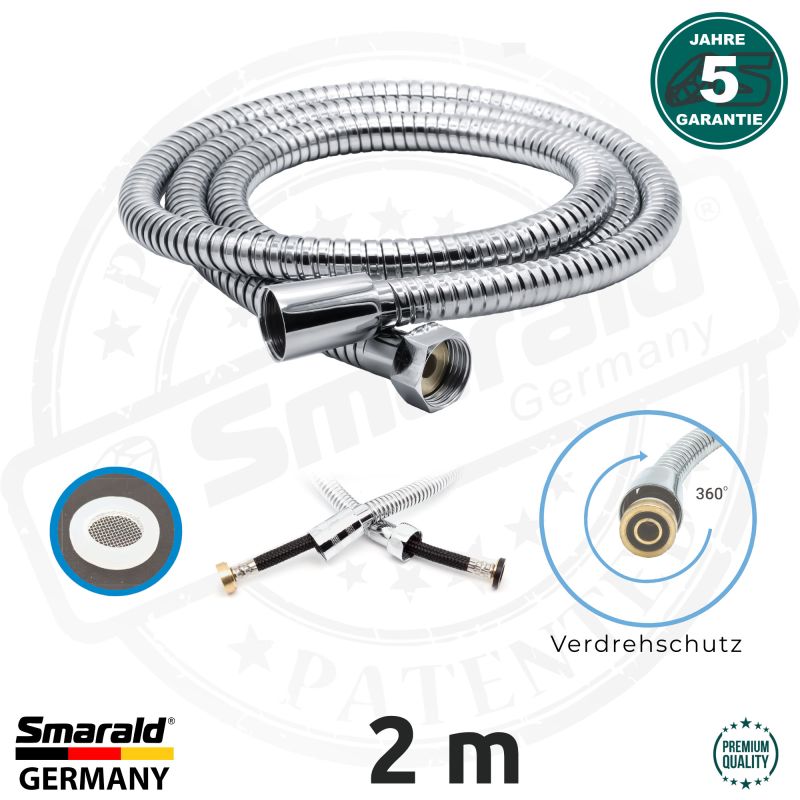
Too long is not good either: the hose then lies in the tub or hangs in a big loop. Smarald® shower hoses are available in 1.5 m and 2 m.
2. The connection: 1/2" (DN 15)
Almost all taps and hand showers in Germany have the standard 1/2" connection, also called DN 15. “1/2 inch” is a designation, not a measurement: the male thread measures about 21 mm. Smarald® shower hoses have this connection. A shower filter such as the DF-007 simply screws in between the tap and the hose.
There are exceptions: in motorhomes and on some very old taps you will find 3/8". If you are unsure, measure it – our guide Which thread do I have? shows you how.
Are shower hoses standardised?
Yes. There is a standard for shower hoses, DIN EN 1113. It specifies how hoses fitted after the tap are tested for dimensions, tightness and durability. The 1/2" connection thread has become established practically everywhere in Europe – which is why a new hose almost always fits your existing tap and shower.
3. Anti-twist protection
While showering, the shower head keeps turning in your hand – and the hose with it. Without anti-twist protection it winds up over time, kinks and cracks. A swivel at the shower end (360°) absorbs this movement. The Smarald® stainless steel shower hoses have this swivel.
Which end goes where?
The end with the swivel goes on the hand shower – where the hose turns while you shower. This end often has a cone-shaped nut, which sits well in the shower holder. The other end goes on the tap or on the shower filter.
Which material?
| Material | Advantages | Disadvantages |
|---|---|---|
| Metal (stainless steel spiral) | robust, durable, classic look | slightly heavier; limescale can build up in the grooves |
| Plastic, smooth | light, flexible, very easy to clean | surface can get scratched or age over time |
| Textile braid | soft, light, modern look | braid absorbs dirt and limescale, hard to clean |
Fitting in two minutes
- Turn off the water and unscrew the old hose from the tap and the shower head – anticlockwise.
- Put a washer into both nuts of the new hose.
- Screw the hose onto the tap and the shower head hand-tight.
- Turn the water on and check for drips – tighten slightly if necessary.
No PTFE tape needed: on a shower hose it is the flat rubber washer in the nut that seals, not the thread. Tape on the thread can even stop the nut from sitting properly on the washer.
Extend rather than shorten
A shower hose cannot be shortened: the ends are firmly crimped, and without them the hose no longer seals. So it is better to buy the right length straight away. In an emergency you can extend it with a 1/2" double nipple (male thread on both sides) that connects two hoses. This is not ideal: every additional joint is a possible leak. A single, longer hose is the better solution.
Good to know for the bathtub
If the hose is so long that the shower can lie in the bath water, in the worst case bath water could be sucked back into the pipe. The standard DIN EN 1717 sets out how drinking water is protected against this; many bath taps have a non-return valve for this purpose. Always hang the shower in its holder after your bath and do not leave it lying in the water. You will find a suitable holder that needs no drilling in our guide Hand shower holder without drilling.
The most common mistakes
- Reusing old washers. They are usually hard and flattened – new washers cost almost nothing.
- Tightening with pliers. The nuts deform or the washer gets crushed.
- Buying too short. Then the hose pulls on the shower holder. Better 20 cm more.
- Mixing up the ends. If the swivel is at the tap, it cannot do its job – the hose will still twist.
Frequently asked questions
How long is a normal shower hose?
Most shower hoses are 1.50 to 1.60 m long. For bathtubs and large showers, 1.75 to 2.00 m is usual.
Does every shower hose fit every shower head?
Almost always, if the tap and shower have the usual 1/2" connection. What matters is an intact washer and the right end on the shower.
Can I shorten a shower hose?
No. The ends are crimped; once cut, the hose no longer seals. Choose the right length straight away.
How often should you replace a shower hose?
There is no fixed interval. At the latest when it drips, has cracks, keeps twisting or the casing comes apart, it is time for a new one.
Why does my shower hose twist?
Because it has no swivel at the shower end – or because the swivel is at the wrong end. A hose with anti-twist protection solves the problem.
Can I retrofit a rain shower with a hose connection?
Yes, with a shower system with a diverter on your existing tap; the hand shower then stays on the normal 1/2" hose. Check the distance between the drill holes and the height beforehand.
In short: measure the length and add 20–30 cm (usually 1.50–2.00 m), check for a 1/2" connection and anti-twist protection, put the swivel on the shower, fit new washers and screw on hand-tight – without PTFE tape. Shortening is not possible, so choose the right length straight away.