
How often to change filters? Overview of all Smarald® filters
Hand on heart: do you remember when you last changed the filter in your shower? Most people don't – which is why a cartridge often stays in twice as long as intended. You only notice when the water just trickles or the limescale marks are back. This overview helps you not to miss the right moment.
Every filter has a limited capacity. Changing it in time keeps the flow and filter performance up. The values below are our recommendations; with hard or very dirty water and high consumption an earlier change may be necessary. A clear sign: the water flow drops noticeably.
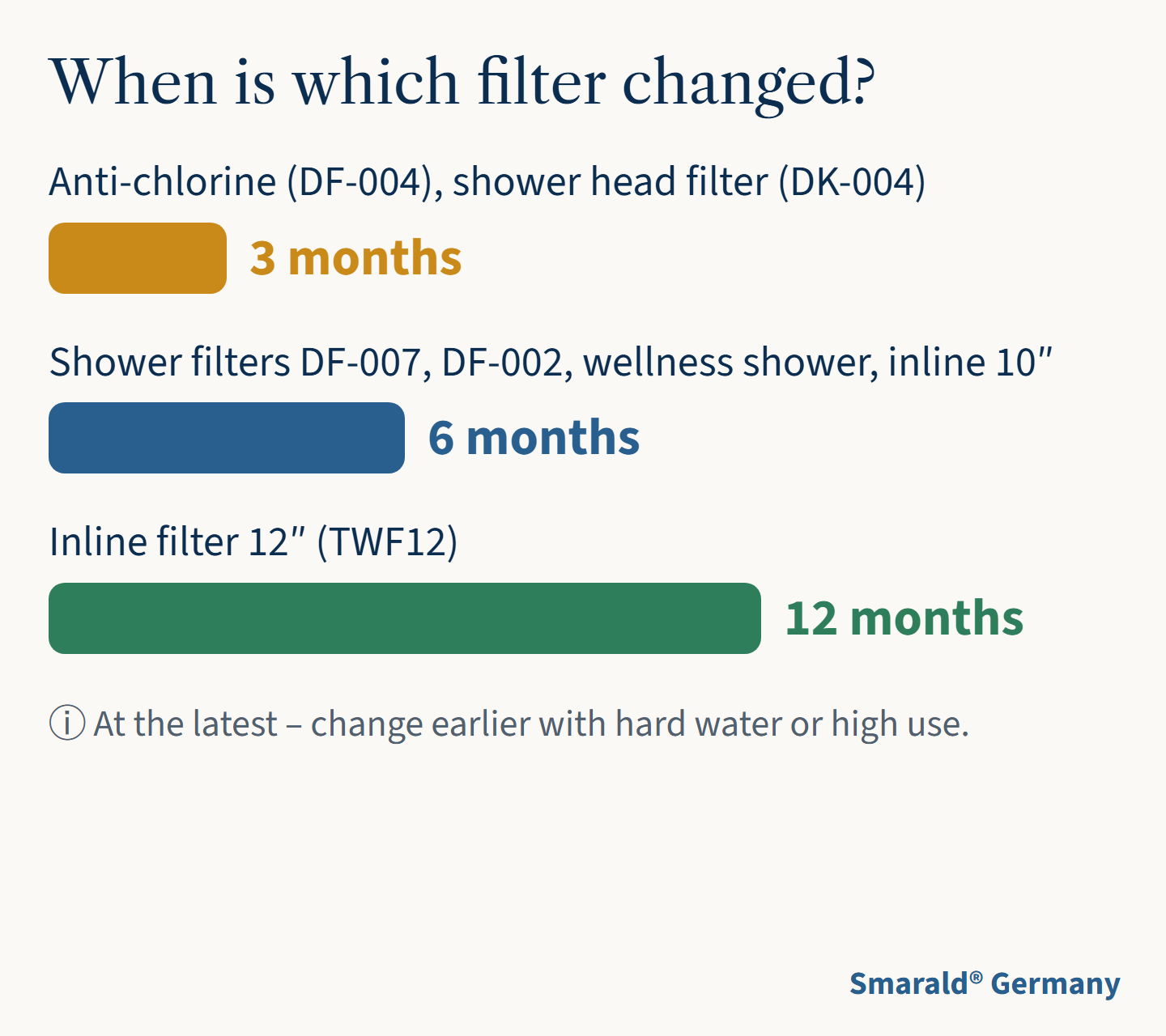
All Smarald® filters at a glance
| Product | Replacement filter | Change at the latest |
|---|---|---|
| Anti-limescale shower filter (DF-007 · compact DF-008) | DF007-EK01 | 6 months |
| Slim anti-limescale shower filter (DF-003) | DFT-EK03 | 6 months |
| Anti-chlorine shower filter for shower and bath (DF-004) | DFT-04 | 3–4 months |
| Universal mineral shower filter (DF-001) and universal shower filter with mineral filling (DF-002) | DFT-EK01 | 6 months / approx. 8,000 l |
| Mineral shower filter (DF-005) and beauty shower filter (DF-006) | on request | 6 months |
| Wellness shower head with 3-stage mineral filter (DK-001 · DK-0003 · DK-002) | DKF-0002 / DKF-0003 | 4–6 months / approx. 8,000 l |
| Hand showers with filter in the handle, 115 mm (DK-004 · SH-1595) | DKF-0004 | 3 months / approx. 5,000 l |
| Hand showers with filter in the handle, 80 mm (H-173DY · HB-CHR-360) | DKF-0005 | 3 months / approx. 5,000 l |
| Inline mineral filter 10" for RO & fridges (TWF10) | TWF10 | 6 months / approx. 8,000 l |
| Inline mineral filter 12" for RO & fridges (TWF12) | TWF12 | 12 months / approx. 2,000 l |
| Drinking water filter system with ultrafiltration (TWA-UF01) | on request | after approx. 10,000 l |
| Travel and sports bottle with mineral filter (TW-0002) | TWZ-005 | approx. 400–800 l |
| Insulated jug with mineral filter, hot & cold (TW-0003) | TWZ-004 | approx. 800 l |
| Outdoor bottle with 2-stage filter 0.1 µm (TW-0004) | TWZ-003 | up to 1,500 l |
| Outdoor water filter 0.1 µm (TW-0005) | entire filter | up to 5,000 l, depending on water quality |
| Outdoor drinking straw with 0.1 µm membrane (TW-0006) | entire filter | up to 1,500 l, depending on water quality |
| Descaling filter for washing machine & dishwasher (WF-001) | WF-001 | 6 months |
Where it says “on request”, we will be happy to tell you the right replacement cartridge – just call or write to us with the model number.
Litres or months – which counts?
Many filters have two figures, for example “6 months / approx. 8,000 l”. Whichever comes first always applies. The number of months applies even if not much water has run through yet: filter material ages, and germs can settle in damp material over time – regardless of how much you shower.
Worked example: how much water does my shower use?
To calculate how much water you use, apply this formula: people × showers per day × minutes × litres per minute = litres per day.
| Household | Litres per day |
|---|---|
| 1 person, 8 min once a day, water-saving shower head (9 l/min) | 72 l |
| 2 people, 8 min once a day each, water-saving shower head (9 l/min) | 144 l |
| 2 people, 8 min once a day each, normal shower head (12 l/min) | 192 l |
Measure the flow yourself: hold the shower in a bucket and time how many seconds it takes to fill 10 litres. Then calculate 10 ÷ seconds × 60 = litres per minute. A conventional shower head often delivers 12–15 l/min, a water-saving one 6–9 l/min.
What determines how long a filter lasts?
- Water hardness: the harder the water, the faster an anti-limescale filter is exhausted. Your water supplier can tell you the hardness.
- Consumption: more people and longer showers mean more litres – see the worked example.
- Water quality: sand, rust or cloudiness clog filters faster.
- Time: even a filter that is used little should come out after the stated maximum period.
How do I know it is time?
- The water flows noticeably weaker than at the start.
- With anti-limescale filters: the white marks on glass and fittings come back.
- With anti-chlorine filters: the smell of chlorine is back.
- With bottles and jugs: the water tastes or smells different from usual.
- The calendar says so – even if everything still seems normal.
What happens if you don't change it?
An exhausted filter no longer holds anything back – limescale and chlorine simply pass through. At the same time it becomes an obstacle: the flow drops. And germs can multiply in old, constantly damp filter material. This applies especially to drinking water filters: drinking water is a foodstuff, and an overdue filter does it no good.
Longer break?
If a filter is not used for more than 4 weeks, replace the cartridge or clean the filter beforehand and store it dry. After a shorter break, such as a weekend, let the water run for a while before you shower or drink.
Storing spare filters and disposing of old cartridges
- Store unused spare filters in their original packaging, in a cool, dry and dark place. If a date is printed on the pack, that date applies.
- Old cartridges usually go in the general household waste, not the recycling bin. Follow the rules of your local council.
How to never forget the change
- Write the date straight on the filter with a waterproof pen.
- Set a reminder on your phone right after installing, e.g. “change shower filter” in 6 months, or sooner with hard water and frequent showering.
- Link the change to fixed dates, e.g. the clock changes in spring and autumn – easy to remember.
- Keep spare filters in stock. With an annual set such as DKF-0003 you also save on shipping costs.
Our guide Changing the shower filter cartridge shows you how to do the change step by step.
Frequently asked questions
Can I use the filter for longer if there are still litres left?
No. The maximum period in months also applies with low consumption, because filter material ages over time and can become contaminated with germs.
Do I need to change it sooner with hard water?
Yes, definitely with anti-limescale filters. The harder the water, the faster the filter material is exhausted.
How long does an unused replacement cartridge keep?
Usually a long time if stored dry in its original packaging. If a date is printed on the pack, go by that.
Is a shower filter a legionella filter?
No. Legionella filters are special membrane filters with their own short change intervals. An anti-limescale or anti-chlorine shower filter does not protect against legionella.
How often do you change a fridge filter?
Usually about every 6 months. Our inline filter TWF10 is replaced after approx. 6 months or 8,000 litres, the TWF12 after approx. 12 months or 2,000 litres. Find out more in our guide Retrofitting an inline filter to your fridge.
Where does the old cartridge go?
Usually in the general household waste. Separate cardboard and plastic packaging as usual.
In short: change the filter no later than the time in the table – or earlier if the number of litres has been reached or the water flows noticeably weaker. Whichever comes first applies. The worked example shows how much water you use.