
Shut-Off Valve for Reverse Osmosis Systems: Function, Installation and Troubleshooting
The tank is full, but water is still running down the drain under the sink? Then the small component that switches a reverse osmosis system off automatically is missing or not working properly: the automatic shut-off valve, also called auto shut-off, 4-way valve or ASO valve (Auto Shut-Off) for short. Here you will learn how it works, where it belongs and how to find faults quickly.
What is a shut-off valve?
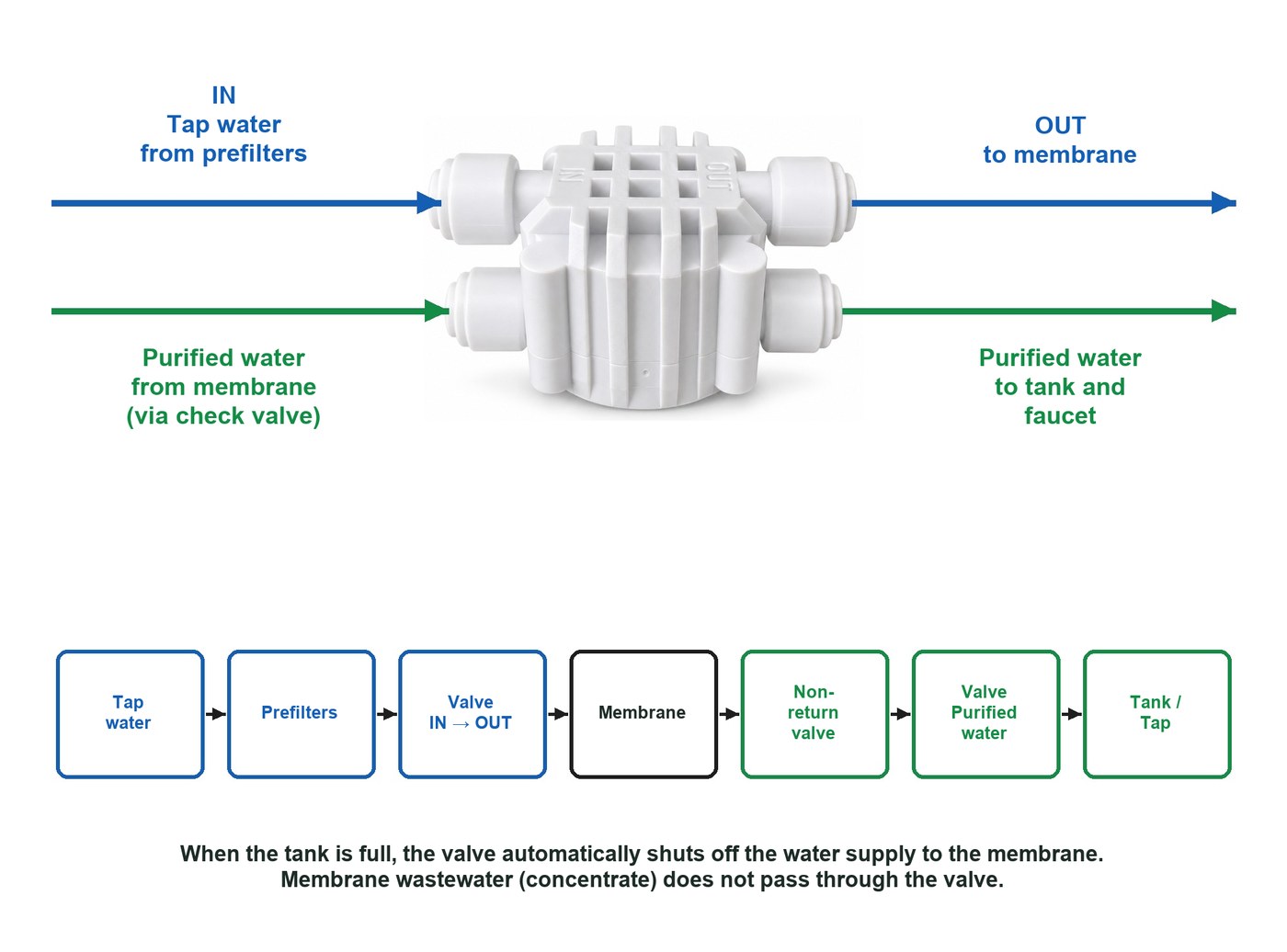
The shut-off valve is a small plastic housing with four push-fit connectors, usually for 1/4" (6.35 mm) tubing. Inside are two chambers separated by diaphragms:
- One chamber carries the tap water on its way from the pre-filters to the RO membrane.
- The other chamber carries the purified water (permeate) on its way from the membrane to the tank and the faucet.
The valve needs no electricity. It works on water pressure alone.
What is it for? Without a shut-off valve, a reverse osmosis system without a pump keeps running even when the tank has long been full. The concentrate (waste water) then flows continuously down the drain, and the pre-filters and membrane are put under unnecessary strain.
How the automatic shut-off works
As the tank fills, the pressure on the purified-water side rises. When the tank pressure reaches a certain proportion of the line pressure, the diaphragm in the valve closes off the supply to the RO membrane. The system stops, and no more waste water flows. When water is drawn at the faucet, the tank pressure drops, the valve opens again and the system resumes production.
The pressure at which the valve switches depends on the model. Typically, it is a tank pressure of roughly half to two thirds of the line pressure. Example: at 4 bar line pressure, the system shuts off at about 2 to 2.7 bar in the tank. For our CP-030A shut-off valve, the manufacturer states a switching point of about 1/2 (± 0.2) of the line pressure.
That is why the tank is never “full to the brim”: how far the tank fills depends on the line pressure. At low pressure, the valve shuts off earlier and there is less water in the tank. This is normal and not a defect.
It won’t work without a check valve
For the shut-off valve to “sense” the tank pressure, the system needs a check valve at the purified-water outlet of the membrane. It prevents water from the tank being pushed back through the membrane. If it is missing or leaking, the system does not shut off or keeps switching on and off. The check valve is often already built into the elbow fitting of the membrane housing; otherwise it can be retrofitted with a push-fit connector with check valve.
Where is the shut-off valve used?
- Under-sink reverse osmosis systems with pressure tank: this is the standard case. Almost every system without a pump has a shut-off valve.
- Aquarium reverse osmosis systems: here the purified water often runs into an open container. Without back pressure, the valve never closes. It does no harm, but it does no good either. It only makes sense together with a float valve in the storage container: the float valve blocks the purified water, the pressure rises, and the shut-off valve stops the supply and with it the waste water.
- Systems with a booster pump or without a tank (direct flow): here the shut-off is usually handled by a pressure switch and a solenoid valve. A shut-off valve is generally not needed there. Follow the instructions for your system.
Installation step by step
- Turn off the water and release the pressure from the system (open the faucet).
- Side marked IN/OUT = tap water: connect the tubing from the pre-filters to IN and the tubing to the inlet of the membrane housing to OUT.
- Opposite side (round cover with screws) = purified water: on one side the tubing from the purified-water outlet of the membrane (after the check valve), on the other side the tubing to the tank or to the tee for tank and faucet.
- Insert the tubing correctly: cut the tubing straight, push it into the push-fit connector as far as it will go and pull it back slightly. If available, fit the locking clip. More on this in the guide How to fit and release Quick&Easy push-fit connectors correctly.
- Turn the water on slowly and check all connections for leaks.
Requirements for reliable shut-off:
- Line pressure of about 3 bar or more, ideally 3.5 to 4 bar. With significantly lower pressure, the system shuts off very late or not at all. In that case, a booster pump will help.
- Pre-charge pressure in the empty tank of about 0.4 to 0.5 bar. Measure it with a tyre pressure gauge at the tank’s valve when the tank is empty.
To find out which tubing fits your system, read the guide Tubing for reverse osmosis systems.
Typical faults and their symptoms
| Symptom | Possible cause |
|---|---|
| Waste water runs constantly although the tank is full | Line pressure too low, check valve faulty, shut-off valve faulty, leak on the purified-water side |
| Tank does not fill | Valve sides swapped, IN and OUT swapped, tank pre-charge too high |
| System keeps switching on and off | Check valve leaking, tank pre-charge too low |
| Humming or vibration after installation | Air in the system, usually disappears after a few days |
| System only stops after hours | Line pressure too low or pre-filters clogged |
Testing the shut-off valve: faulty or not?
Test 1: Does the system shut off?
Draw some water so that the system runs. Then close the ball valve on the tank: this makes the system “think” the tank is full. After 3 to 5 minutes, no more waste water should flow. Listen at the drain or briefly disconnect the waste water tubing.
- Waste water stops: the valve and the check valve are working. Then check the line pressure and the tank pre-charge.
- Waste water keeps running: continue with test 2.
Test 2: Check valve or shut-off valve?
Tank full, tank valve open, close the water supply to the system. If water still runs out of the waste water tubing, the check valve is leaking. If nothing runs, the shut-off valve is the cause.
When should it be replaced?
A shut-off valve usually lasts a long time. It must be replaced if it no longer shuts off even though the pressure, tank and check valve are fine, for example because the diaphragm in the valve is worn.
Frequently asked questions
Can the switching point be adjusted?
No. It is fixed by the design and depends on the line pressure.
How long does waste water keep running after the tank has filled?
The valve does not close abruptly but gradually as the tank pressure rises. A short run-on is normal. If it takes a very long time, the line pressure is usually too low.
Will the valve fit my system?
If your system has tubing with a 1/4" (6.35 mm) outer diameter and push-fit connectors, a 4-way valve with 1/4" connections will generally fit. Compare the dimensions and connections with your old valve.
Do I also need a check valve?
Yes, without a check valve after the membrane, the automatic shut-off does not work. In many systems it is already installed.
Do I need the valve if my system has a pump?
Usually not. Systems with a pump generally shut off via a pressure switch. The instructions for your system are what count.