
Water hardness: how to find out how hard your water is
The detergent pack says “dose according to water hardness”, the inside of the kettle has turned white again, and the glass shower screen shows every single drop. That is usually when people start to wonder: how hard is my water, actually? The good news: you can find out in a few minutes – usually without even measuring.
What does “water hardness” mean?
Tap water contains dissolved minerals, mainly calcium and magnesium. These are known as hardness minerals. The more of them the water contains, the “harder” it is. How much that is usually depends on which rock layers the water flows through in your region – which is why the hardness can be different even in the next town.
When water is heated or evaporates, some of the hardness minerals are left behind as a solid deposit: limescale. Hence the white rings and crusts.
This guide is about one consequence of hard water: limescale.
°dH and mmol/l: the two units
In Germany, hardness is usually stated in two ways:
- °dH – “German degrees of hardness”, the familiar unit.
- mmol/l – millimoles per litre; this is the unit in which the German Detergents and Cleaning Products Act (WRMG) defines the hardness ranges (expressed as calcium carbonate).
To convert: 1 mmol/l corresponds to about 5.6 °dH. If your water supplier states 2.0 mmol/l, for example, that is around 11 °dH.
The three hardness ranges
The German Detergents and Cleaning Products Act divides water into three ranges. The dosage instructions on detergent packs are also based on these ranges.
| Hardness range | mmol/l calcium carbonate | °dH (approx.) |
|---|---|---|
| soft | below 1.5 | below 8.4 |
| medium | 1.5 to 2.5 | 8.4 to 14 |
| hard | above 2.5 | above 14 |
On older appliances or documents you may still sometimes find a classification into ranges 1 to 4. This no longer applies – if in doubt, go by the °dH value.
How to find out your water hardness
- Ask your water supplier: Your local water supplier publishes the hardness range, often on its website (search for “water hardness” plus your town or postcode).
- Check your water bill: The hardness range is often stated on the annual bill or an enclosed sheet.
- Ask your landlord or property management: If you do not receive your own water bill.
- Measure it yourself: Test strips for total hardness are available in shops. Hold a strip in the water briefly and compare the colour with the scale. The result is a guide value, but it is usually sufficient for everyday purposes.
If you have a water softening system in your home, the hardness at your tap may be lower than your supplier’s figure. In that case, only measuring will help.
What hard water does in everyday life
- Limescale marks on glass, tiles and taps – especially where drops dry.
- Scaled-up shower heads: The nozzles become clogged and the spray becomes uneven.
- Heating elements in washing machines, dishwashers and kettles build up limescale, because more limescale is deposited when water is heated.
- Detergent: With hard water, manufacturers recommend a higher dose. If you know your hardness range, you can dose correctly – rather than using too much “just to be safe”.
What you can do
Shower
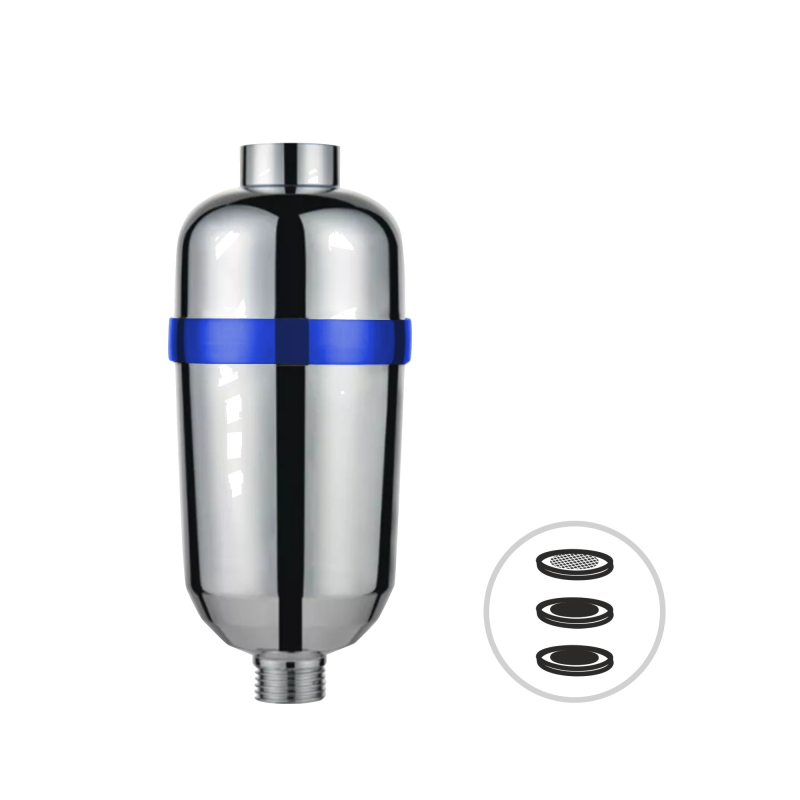
A scaled-up shower head can usually be cleaned – you can read how to do this gently in Limescale in the shower head: removal and prevention. If you would like to reduce limescale before it even reaches the shower head, you can screw an anti-limescale shower filter DF-007 between the mixer tap and the shower hose. Its cartridge with ion-exchange resin and zeolite binds some of the hardness minerals and can therefore reduce limescale deposits on the shower head, taps and shower screen. How much depends on your water hardness and the amount of water. The effect diminishes with use; the cartridge is replaced regularly, sooner with hard water. More on this: Shower filters against limescale.
Washing machine and dishwasher
The WF-001 descaling filter is fitted between the tap and the inlet hose. Its polyphosphate filling helps to prevent limescale deposits on heating elements, the drum and water-carrying components. It is designed for cold water. Installation and care: Descaling filters for washing machines and dishwashers.
Many dishwashers also have a built-in water softener, which you set according to your water hardness – the instruction manual explains how.
Neither filter replaces a water softening system for the whole house, and neither descales an appliance that is already scaled up.
The most common mistakes
- Confusing °dH and mmol/l. “3” in mmol/l is already hard (around 17 °dH), whereas in °dH it is very soft. Always check the unit.
- Using the value from the next town. Hardness can vary from place to place. Use the value from your own supplier.
- Dosing detergent by feel. The pack states the amount for each hardness range – checking once is enough.
- Fitting a filter and forgetting about it. An exhausted cartridge or filling no longer works. Make a note of the replacement date straight away.
In short: Water hardness means how much calcium and magnesium is in the water. Your water supplier will tell you the hardness range; soft is below 8.4 °dH, medium 8.4–14 °dH, hard above 14 °dH (1 mmol/l ≈ 5.6 °dH). With this value, you can dose detergent correctly and decide whether a filter for your shower or washing machine is worthwhile for you.
Questions about our filters? Write to us at kontakt@smarald.com – we are happy to help.